
Custom
Edge Grain Butcher Block
Edge grain butcher block is a durable, linear hardwood surface for custom countertops, islands, bar tops, and work areas. Armani Fine Woodworking builds each piece to the project’s dimensions, species, thickness, and intended use, including thick butcher block countertops up to 7 ½ inches.

Understanding Edge Grain Butcher Block Construction
Edge grain butcher block is formed by orienting wood so the fibers run lengthwise across the surface, creating a linear, continuous pattern. This construction provides a stable, durable surface suited for a wide range of applications.
Because edge grain butcher block is laminated from individual hardwood staves, the final thickness can be specified for the project rather than limited to standard stock sizes. Armani Fine Woodworking can build custom edge grain butcher block surfaces up to 7 ½f" thick, depending on species, dimensions, use, and installation conditions.

All our edge grain butcher blocks are constructed using full-length staves rather than short finger-jointed sections. This produces a more continuous visual pattern while reducing interruption points where moisture intrusion and long-term separation are more likely to occur.
Edge Grain Butcher Block for Kitchens & Islands
Edge grain butcher block is a practical and versatile surface suited for full kitchen installations, substantial islands, bar tops, heavy work surfaces, and everyday use. Its linear pattern is visually quieter than end grain and integrates easily into a wide range of interiors.
For projects that call for a thicker butcher block countertop, edge grain construction provides the scale and visual weight without relying on applied build-ups or decorative aprons. Thickness should be planned with the overall design, support structure, overhangs, weight, finish, and site conditions in mind.
It is also a functional chopping surface for general food preparation, offering a more practical alternative to end grain without requiring the same level of maintenance.
While less formal than wide-plank configurations, its linear structure aligns well with contemporary design. At the same time, its traditional construction makes it a natural fit for kitchens that prioritize function over formality.
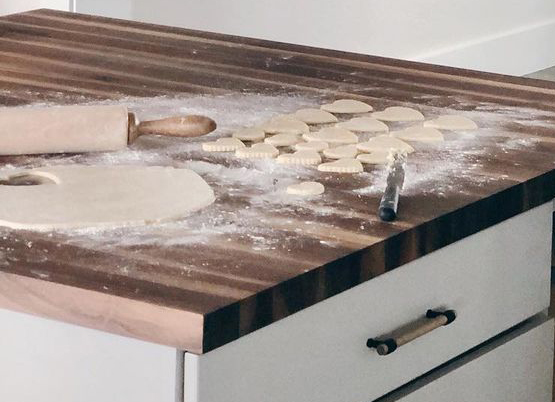
How Edge Grain Surfaces Perform Over Time
Edge grain butcher block is more dimensionally stable than end grain, but like all solid wood, they will respond to changes in humidity and environment.
Under regular use, the surface will develop subtle signs of wear in active areas. These marks are typically more visible than on end grain, but remain consistent with normal use and can be managed through routine maintenance.
Appearance will shift slightly over time as the material acclimates and finishes are maintained or reapplied. These changes are expected and contribute to the overall character of the surface.
Material Selection & Composition
Edge grain butcher block is built from boards oriented with the grain running lengthwise, creating a continuous linear pattern.
Material is selected and arranged to emphasize natural grain variation while maintaining a cohesive flow across the surface. Boards are paired to avoid abrupt transitions, and the overall layout is adjusted to balance color and tone.

The result is a cohesive, structured surface with a level of consistency suited to larger installations and integrated layouts.
Important Considerations
Edge grain butcher blocks are more dimensionally stable than end grain, but like all solid wood, they will expand and contract in response to changes in humidity and environment.
Proper installation is required to accommodate this movement. Continuous support and allowance for expansion must be considered in both cabinetry and attachment methods.
Thickness is determined by overall size and application. Larger spans require increased thickness or structural support, and these requirements should be addressed early in the design process.
Finish & Care
Finish selection depends on how the surface will be used, maintained, and expected to age over time. Different applications place different demands on the material, particularly in kitchens where food preparation, moisture, and daily wear must all be considered.
We evaluate finish systems during the design process to align the final surface with both performance expectations and long-term maintenance requirements.
Active Food Preparation & Chopping
Mineral Oil
Mineral oil remains the preferred finish for active food preparation and regular chopping applications. Because the oil penetrates the exposed wood fibers, the surface can be refreshed easily through routine reapplication.
Regular maintenance is required, typically every 1–2 weeks depending on use and environment. A beeswax conditioner is recommended to slow evaporation and provide additional surface protection.
General Kitchen & Light-Use Surfaces
Tung Oil
Tung oil provides increased surface protection with reduced maintenance, typically requiring reapplication every 3–6 months depending on use and environment.
While suitable for general food preparation and occasional cutting, it does not allow the fibers to recover in the same way as mineral oil, resulting in more visible signs of use over time.
Architectural & Low-Maintenance Applications
Monocoat
Hardwax oil systems such as Rubio Monocoat provide a natural appearance with lower maintenance requirements while preserving the look and feel of the wood.
Surfaces should still be kept clean and free of standing water, as prolonged exposure can lead to staining. These systems are not intended for active chopping applications.
Impermio
Impermio creates a sealed, highly durable surface with minimal maintenance requirements. It is well suited for areas exposed to frequent moisture or staining, including installations with sinks or cooktops where protection is the priority.
Because the finish forms a film layer on the surface, it produces a less tactile and less natural wood feel compared to penetrating oil systems. This finish cannot be spot-repaired and is not intended for cutting or chopping.
Finish selection should be based on how the surface will be used, as each system involves trade-offs between maintenance, repairability, durability, and tactile feel.
Learn more about maintenance and long-term care.
Finish & Care
Finish selection and care requirements are determined during the design process, based on how the surface will be used and maintained over time.
We offer multiple finish systems, each suited to different applications and levels of maintenance.
Selection should be based on how the surface will be used, as each system involves trade-offs between maintenance, repairability, and durability.
Learn more about maintenance and long-term care.
Our Approach
Each custom butcher block is developed specifically for how it will live and be used within the space, not produced as a standard, off-the-shelf product.
This process ensures the surface performs in alignment with its intended use.
Request a Consultation
Solid wood surfaces require careful planning, coordination, and proper installation.
Project Consultation
Share project details, dimensions, drawings, finish preferences, or reference imagery. We review each inquiry to determine scope, coordination requirements, and material suitability.
Wood Samples
Order hardwood samples to evaluate species, grain, color, texture, and finish options within your space and lighting conditions.


