
Custom End Grain Butcher Block
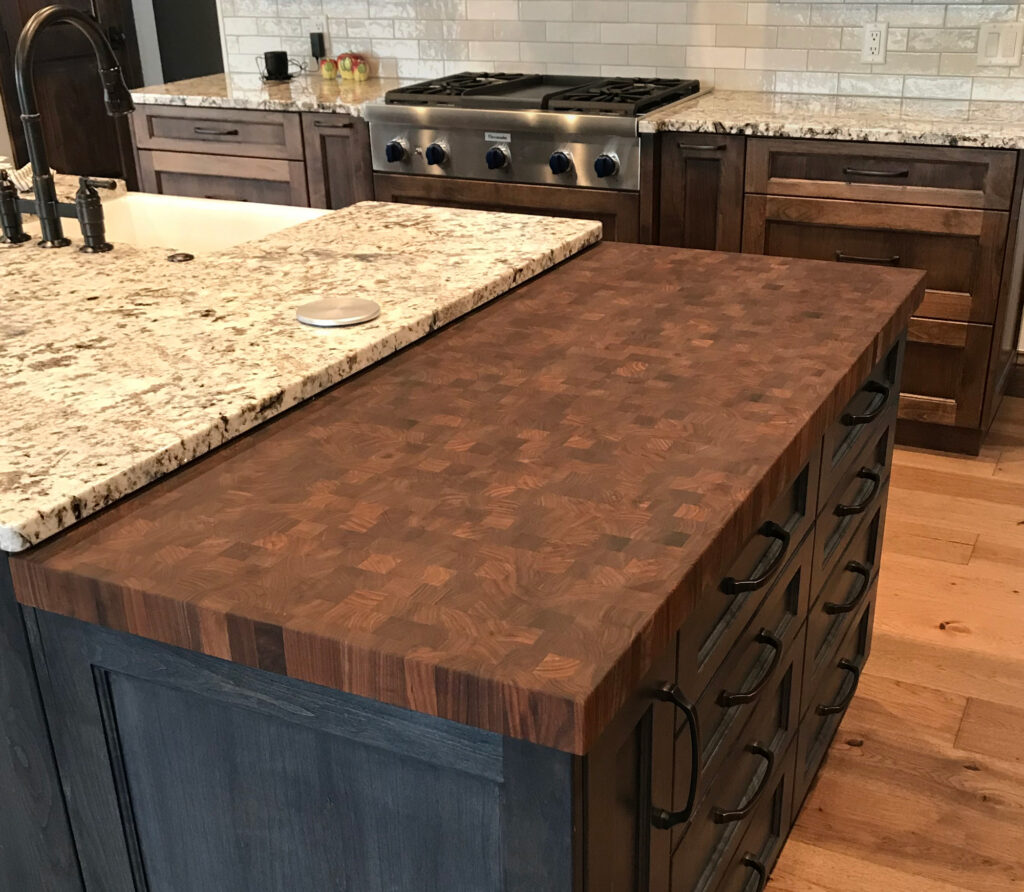
End grain butcher block is constructed from the exposed ends of wood fibers, resulting in exceptional durability, visible depth, and a distinctly different cutting response than edge-grain construction.
Understanding End Grain Butcher Block Construction
End grain butcher block is formed by orienting the wood so the fibers stand vertically at the surface. Under use, the fibers separate slightly to accommodate a knife’s blade, then return to position. This reduces visible wear and has less impact on the knife’s leading edge.
For this reason, end grain is widely preferred in chef-driven kitchens, where maintaining a sharp blade is critical.

This is not a variation of standard butcher block. It is a fundamentally different construction method with distinct performance characteristics, costs, and requirements.
End Grain Butcher Block for Kitchens & Islands
Custom end grain butcher block countertops are preferred where food preparation is central, as well as in spaces where that level of function and presence is intentionally expressed.
Designing for End Grain Movement
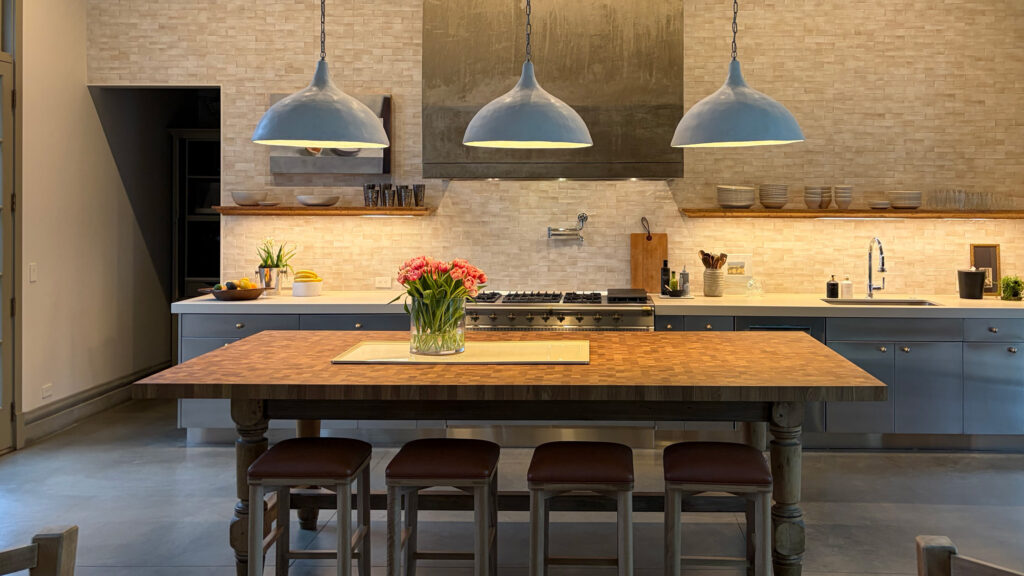
End grain butcher block behaves differently than other construction styles. With the wood fibers exposed across the surface, it absorbs and releases moisture more readily. This results in more pronounced movement, occurring in both length and width.
Because moisture exchange occurs through both the top and bottom faces, airflow beneath the surface is required. If airflow is restricted, only the top face can respond to changes in humidity, which can cause the surface to curl.
Each piece is unique. Final appearance depends on species, layout, and installation conditions. Learn more about how solid wood responds to environment and use in Living with Wood.
Material Selection & Composition
Most end grain butcher block is produced by fabricating a single large panel, then cutting and reorienting it vertically. While efficient, this method often results in visible repetition, with patterns from the original boards remaining apparent across the finished surface.
Our process is intentionally different.
We construct multiple panels and work from a broader range of material. Each section is evaluated before cutting, and the final layout is reviewed to avoid grouping pieces from the same source panel.
Rather than a repeating checkerboard, surfaces are composed in an offset layout that distributes variation across the field. This creates a more varied, non-repetitive pattern and avoids the visual rhythm typical of single-panel construction.
The result is a piece that reads as more organic and less manufactured. Variation is controlled, not repeated, creating a more continuous visual field.
This process is more material- and labor-intensive, but it allows for a level of control and visual balance that cannot be achieved through single-panel construction. Checkerboard layouts can be produced when specified but are not the default.
1Standard layouts use blocks approximately 1 ¼ inch square for most species, with larger formats, typically around 1 ¾ inch, used for select materials. Block size can be adjusted or intentionally varied to create a more irregular composition.
Adhesives are selected for performance in demanding environments. We use a waterproof adhesive system approved for indirect food contact, designed to maintain bond integrity under repeated moisture exposure.
End grain surfaces are not finished through machine sanding alone. The changing grain direction requires hand sanding to achieve a consistent finish.
This step is essential to the final quality of the surface and cannot be replicated through automated processes. Learn more about our fabrication approach and material process.
Important Considerations
End grain butcher block requires deliberate planning and coordination.
Drawings, approvals, and installation conditions directly impact performance and longevity. Review our Installation & Care guidelines for planning and maintenance considerations.
Finish & Care
Finish selection depends on how the piece will be used, maintained, and expected to age over time. Cutting applications, prep surfaces, and architectural installations each place different demands on the material.
We prefer evaluating finish systems collaboratively during the design process so the final surface aligns with both performance expectations and long-term maintenance.
Cutting & Food Preparation Surfaces
Mineral oil remains the preferred finish for active cutting applications. It allows the exposed wood fibers to recover more effectively from repeated knife contact, helping minimize visible wear over time.
Regular reapplication is required, typically every 1–2 weeks depending on use and environmental conditions. We also recommend our organic beeswax conditioner to slow evaporation and improve surface protection.
Light-Use Prep & Kitchen Surfaces
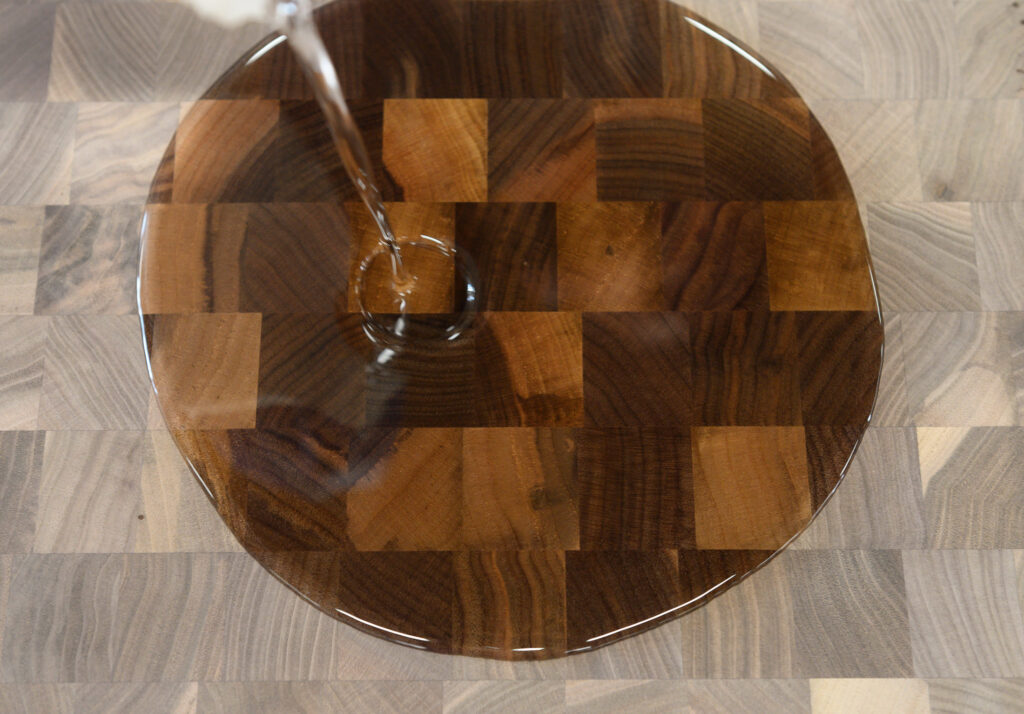
Tung oil offers increased surface protection with less frequent maintenance, typically every 3–6 months depending on use and environment. While suitable for light or occasional cutting, it does not allow the fibers to recover in the same way as mineral oil, resulting in a more visible patina over time.
Architectural & Low-Maintenance Applications
For surfaces where cutting performance is not required, hard-wax oil systems such as Rubio Monocoat provide a lower-maintenance finish while preserving the appearance and feel of the wood. Pieces must still be cleaned promptly, as standing water or staining agents can penetrate if left on the material.
Impermio provides the highest level of water resistance and durability with minimal maintenance requirements, but is not repairable and is not intended for cutting applications.
Our Approach
Each custom butcher block is developed specifically for how it will live and be used within the space, not produced as a standard, off-the-shelf product.
This process ensures the surface performs in alignment with its intended use.
Request a Consultation
Solid wood surfaces require careful planning, coordination, and proper installation.
Project Consultation
Share project details, dimensions, drawings, finish preferences, or reference imagery. We review each inquiry to determine scope, coordination requirements, and material suitability.
Wood Samples
Order hardwood samples to evaluate species, grain, color, texture, and finish options within your space and lighting conditions.


