
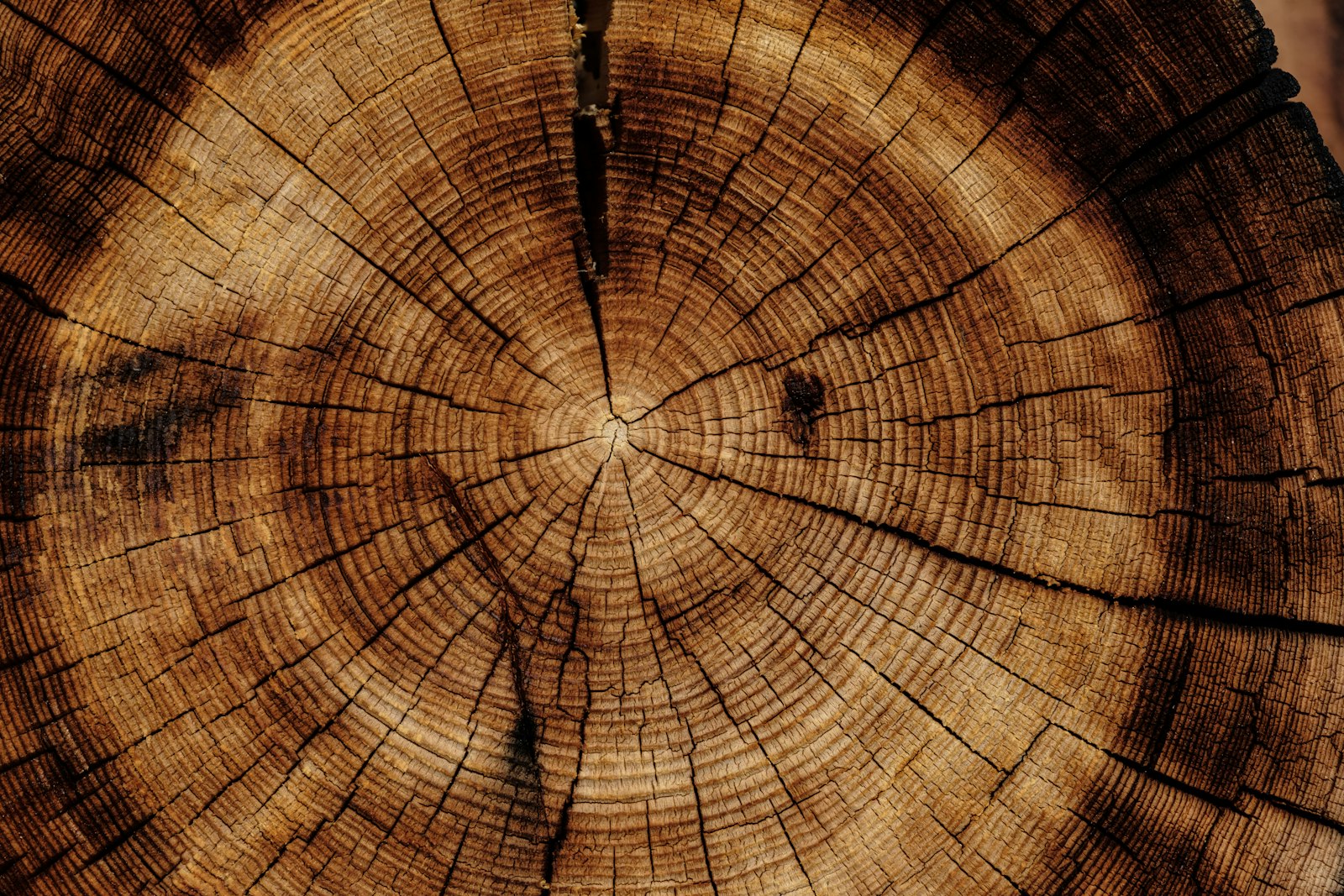
Solid wood breathes. It takes on moisture in humid conditions and releases it when the air is dry, expanding and contracting across the grain by a fraction of an inch. Usually that happens slowly enough that nothing comes of it. When it doesn’t — when a top splits or cracks — the explanation goes back to how the tree grew.
The grain in a solid wood top is the pattern that results from the tree’s annual growth. Every year a tree lays down a new layer of wood on its outside: a pale, open, fast-grown band in spring, then a darker, denser band as growth slows through late summer. One pale band plus one dark band is one year. Those are the rings children learn to count on a stump, and they run the entire height of the tree.
A board is those rings sliced at an angle. The lines running down a plank are the same annual layers, cut lengthwise and opened out. When you run your hand across a solid wood surface, you are running it across a chronology of the tree’s life.
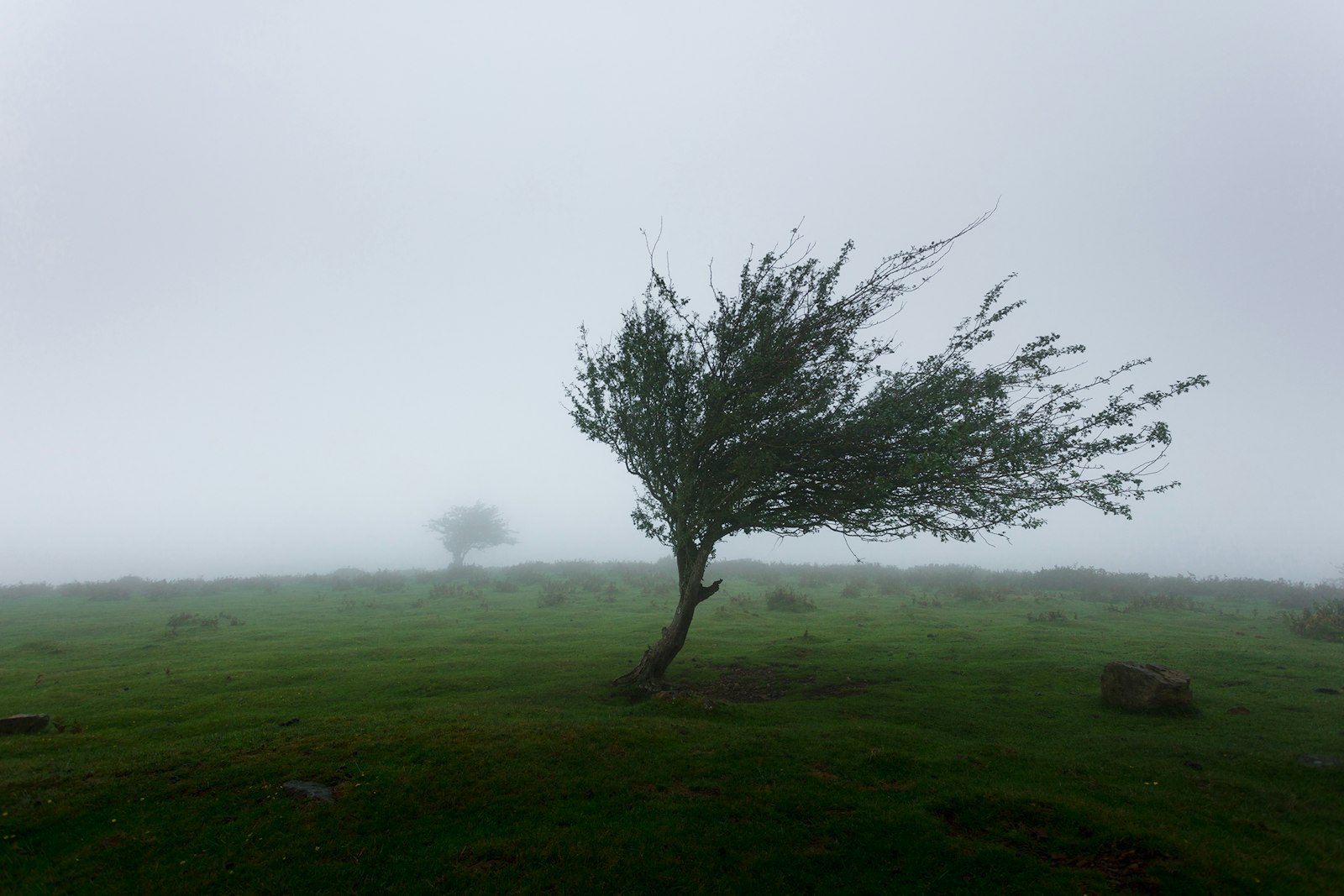
A tree spends its whole life solving one problem: stand up and bend in the wind without breaking. Everything about its structure answers that. Wood cells are long hollow tubes running vertically, bundled together and reinforced along their length. That makes them strong and springy in exactly the direction the tree needed to flex, and it is why a board barely changes length as it takes on and gives up moisture. Along the grain, wood is nearly still.
Sideways, the tree never needed the same strength. Nothing in a trunk’s life pulls it apart across its width. So wood is enormously weaker in tension across the fibers than along them — by a factor of more than twenty. Essentially everything that goes wrong with a wood panel goes wrong in that direction.
Which is why a failed top splits where it does. Modern adhesives are stronger than the wood around them, so when a panel is pushed past what it can take, it does not come apart at a glue seam. It splits through the board itself, running lengthwise with the grain. The joint holds. The wood is what gives.
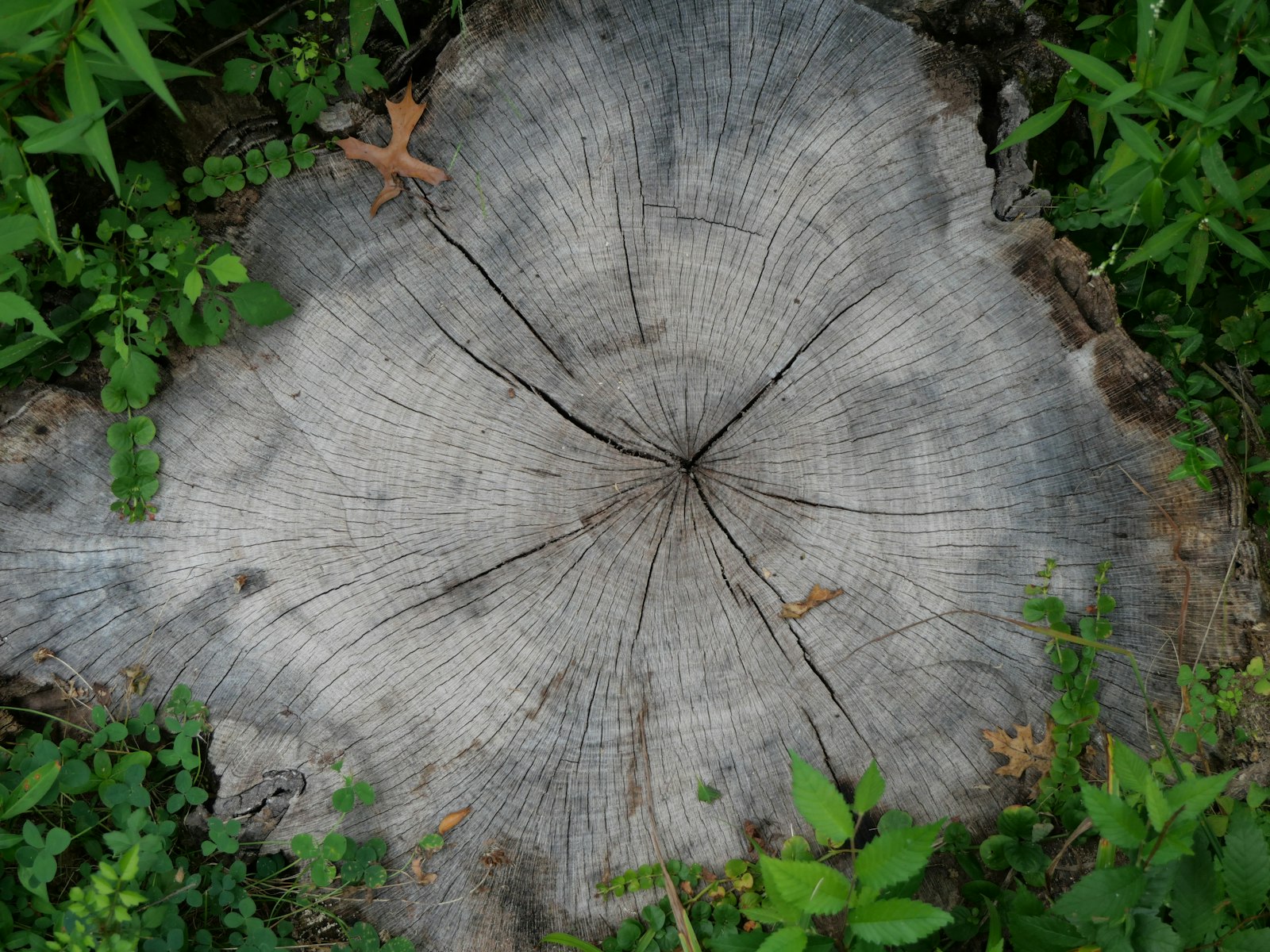
Look at the cut face of almost any stump and you will find cracks running from the center outward, straight across the rings. A living tree does not crack this way. Wood does not begin to shrink at all until it has dried below roughly thirty percent moisture content, and standing timber sits well above that. These checks open after felling. A crosscut log gives up moisture through its exposed ends much faster than through its sides, so the ends dry first, and shrink first.
A tree is a cylinder before it is anything else, and the two directions that matter are the same as a circle’s. Radial movement runs out from the center, the way a radius does. Tangential movement runs around, following the curve of the rings. Wood moves about twice as much tangentially as radially. Longitudinal movement, up the trunk, barely exists.
As a log or stump dries, its shrinkage is governed by its geometry. It wants to shrink twice as much tangentially as radially. A circle cannot do that: around and across are locked in fixed proportion, so they can only shrink by the same percentage. The round resolves it by ceasing to be round. It tears, and radial is the only direction open.
Sawing breaks the trap. A properly sawn board is made up of arcs, not whole rings, and an arc is free to move. The two-to-one ratio survives — nothing about the wood has changed — but it is no longer held in a closed round, so nothing forces a tear. What is left is ordinary movement across the width.
But movement across the width is not one direction. In a face grain top the boards lie flat and their rings run roughly parallel to the surface, so movement across the width is tangential, the direction that moves most. That is where the tension collects, and a split runs down through the thickness on the same radial plane the stump tears on. Stand the same stock on edge, as edge grain butcher block does, and the directions rotate with it. The movement now points through the thickness, the width barely travels, and failures run along the grain instead. The wood does the same thing every time. Where it shows depends on which way it was turned.
Like a sponge, a wood panel dries from the outside in: the surface gives up moisture faster than the core can replace it. The surface wants to shrink and the wetter wood beneath holds its shape. That puts the surface in tension across the grain, pulling the fibers apart from one another, which is where wood is weakest. Push it far enough and it fractures: checks open on the face and splits run with the grain. They may narrow when the humidity returns, but they do not heal. A crack is not movement. It is damage.
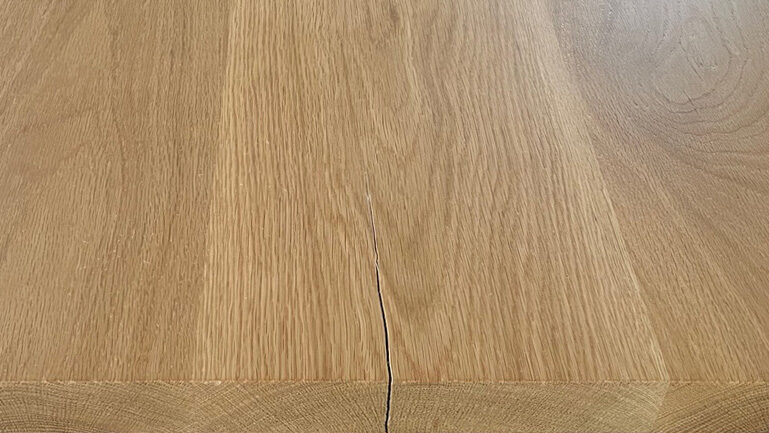
A white oak table left in an unheated Montana garage over several spring months of temperature and humidity swings. The split runs with the grain, through the board itself rather than along a glue line.
When a panel gains moisture, everything reverses. The surface swells first, the drier core restrains it, and the surface goes into compression, the fibers pressed together rather than pulled apart. Wood is strong in compression, and more importantly it fails gently there. The cells yield very slightly instead of rupturing. The worst case, across many years and many cycles, is a panel that ends up a fraction narrower than it began. Nothing fractures, and no glue joint lets go.
Every reputable shop buys kiln-dried lumber; wood simply does not hold the number it left the kiln with. It comes back into balance with whatever air it is milled and glued in, and that is the air that ships with it.
A top built in humid air and delivered into a dry house has to give up moisture, and giving up moisture is what cracks wood. A top built dry has already done its shrinking. Almost anywhere it lands is damper than the air it was made in, which is the move wood forgives. Ours are built in Denver, in some of the driest air in the country. Why that matters is here.