
Sapele Mahogany
Custom Sapele Mahogany countertops, islands, tables, and architectural surfaces crafted from solid hardwood selected for its rich color, refined grain character, and architectural warmth.
Known for its deep reddish-brown tones, distinctive ribbon-like figure, and elegant natural luster, Sapele Mahogany is particularly well suited for contemporary interiors, luxury residences, hospitality environments, and projects where warmth, visual depth, and sophisticated material character are essential.
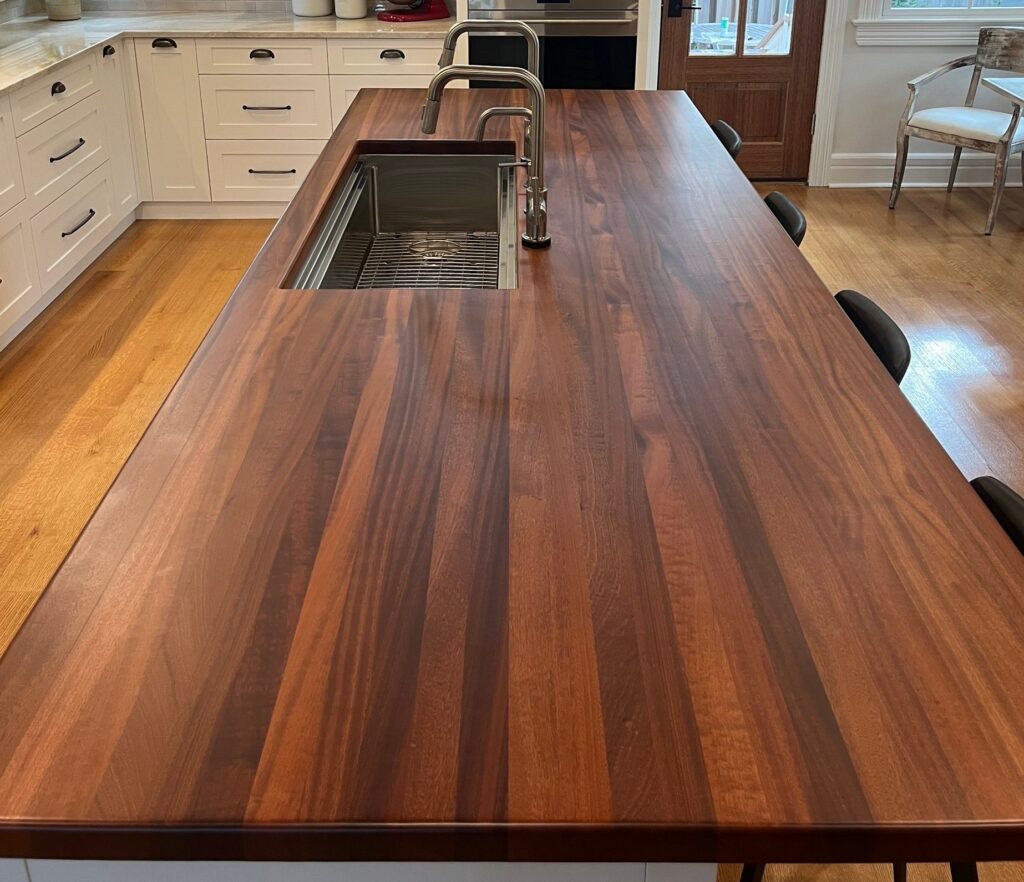
Sapele Mahogany is distinguished by its rich reddish-brown coloration and striking iridescent grain, which gives the wood a distinctly modern architectural character. Its interlocking grain creates a natural shimmering effect, with ribbon-like patterns that shift in depth and reflectivity as light moves across the surface.
This dynamic visual quality makes Sapele particularly compelling in contemporary interiors, where its linear grain, natural luster, and warm color introduce movement and sophistication without relying on elaborate detailing. When selected for its ribbon figure, Sapele brings a refined, almost three-dimensional quality to custom countertops, kitchen islands, tables, and architectural surfaces.
Native to tropical regions of Africa, Sapele (Entandrophragma cylindricum) is a hardwood often marketed as Sapele Mahogany. Although it is not a true mahogany of the Swietenia genus, it shares many of the visual qualities associated with traditional mahogany while offering its own distinctive grain character and performance properties.
Unlike more neutral species such as white oak or hard rock maple, Sapele introduces a deeper, more saturated color palette. Its combination of rich color, iridescent figure, and refined grain structure makes it particularly well suited for contemporary residences, luxury hospitality environments, and architectural spaces where natural wood serves as a defining design element.
Armani Fine Woodworking builds custom Sapele Mahogany countertops, kitchen islands, tables, shelving, desktops, and architectural surfaces from solid hardwood selected and arranged to balance color, grain flow, figure, and long-term performance.
Because Sapele is a natural material, variations in color, grain direction, ribbon figure, and reflectivity should be expected. These characteristics contribute to the individuality of each finished surface and are an essential part of the wood's distinctive architectural appeal.
Why Designers Choose Sapele Mahogany
Sapele Mahogany's character comes from:

Sapele Mahogany is frequently specified for:
Sapele pairs particularly well with:
Material Characteristics
Material
African Sapele (Entandrophragma cylindricum)
Sustainability
Sapele is sourced from tropical forests in Africa, where responsible forest management, harvest practices, and chain-of-custody documentation are important considerations.
FSC-certified material may be available upon request for qualifying projects, subject to supplier availability and verification. Because sourcing conditions vary, certification and documentation should be confirmed during material selection.
Color Range
Golden brown to medium reddish-brown when freshly milled, typically developing deeper copper, red, and brown tones with age and exposure to light.
Grain Character
Frequently interlocked, with straight to ribbon-like figure depending on the orientation of the cut. Quarter-sawn material can display distinctive alternating bands of light and dark grain.
Texture
Fine to medium texture with natural luster and a relatively uniform surface appearance. Interlocking grain can create a subtle three-dimensional visual effect.
Relative Hardness
Sapele has a Janka hardness rating of approximately 1410, placing it above American Black Cherry and genuine mahogany in hardness, while remaining softer than exceptionally hard domestic species such as hickory.
Its combination of hardness, density, and stability makes it suitable for a wide range of residential and commercial interior surfaces.
Typical Applications
Design Compatibility
Sapele Mahogany works particularly well in:
Its deep color and distinctive grain figure allow Sapele to function as either a subtle architectural foundation or a prominent design feature.
Depending on board selection, grain orientation, and finish, Sapele can range from relatively quiet and uniform to highly figured, with pronounced ribbon-like movement across the surface.
Wide-plank Sapele surfaces emphasize the natural figure and continuity of the wood, while edge-grain constructions create a more linear, structured appearance.
End-grain Sapele can also introduce a distinctive geometric texture, although construction suitability and availability should be evaluated for the specific application.
Thickness Availability
Wide-plank / face-grain Sapele Mahogany surfaces are available in 1 ½" thickness.
Edge-grain and end-grain constructions may accommodate additional thickness options depending on material availability, project dimensions, and application requirements.
Final thickness and construction options are confirmed during project review.
Color & Aging
Sapele Mahogany naturally displays warm golden-brown to reddish-brown coloration, often accompanied by subtle variation in grain reflectivity and figure.
Over time, exposure to light and environmental conditions generally deepens the wood's color, producing richer copper, red, and brown tones. This natural aging process contributes to the depth and character associated with Sapele.
Quarter-sawn material may display pronounced ribbon figure, where alternating grain direction reflects light differently across the surface. This effect can make the wood appear lighter or darker depending on viewing angle and lighting conditions.
Finish selection can significantly influence the perceived warmth, saturation, and contrast of the wood.
Sample approval is recommended whenever color expectations, ribbon figure, or overall tonal consistency are important to the design.
Performance & Durability
Sapele is a dense, moderately hard hardwood with favorable strength and durability characteristics for interior architectural applications.
Its combination of hardness, dimensional stability, and refined appearance makes it particularly suitable for countertops, tables, desks, and other surfaces where both performance and visual quality are important.
Although Sapele is harder than many traditional furniture hardwoods, it remains a natural wood surface and can develop scratches, dents, and signs of wear through regular use.
Its interlocking grain can also require careful machining and surface preparation to achieve a consistently smooth finish, particularly on highly figured material.
Like all solid wood surfaces, Sapele expands and contracts seasonally with changes in humidity. Proper installation and environmental control are important for long-term performance.
Finish Considerations
Sapele Mahogany's naturally rich coloration and iridescent grain respond distinctly to different finish systems. Finish selection can enhance the wood's reddish-brown tones, emphasize its ribbon-like figure, and influence how light interacts with the finished surface.
Different finishes primarily influence:
Clear, matte finishes can preserve a more natural appearance while allowing the wood's grain and figure to remain visible.
Penetrating oil finishes generally deepen the reddish-brown coloration and can enhance the visual contrast created by Sapele's interlocking grain.
Protective film finishes may be appropriate for surfaces where moisture resistance, stain protection, and reduced maintenance are priorities.
Because Sapele naturally develops richer coloration over time, finish selection should account for both the initial appearance and expected aging of the material.
Sample approval is recommended whenever precise color, sheen, or grain presentation is important.
Natural Variation
Sapele Mahogany naturally contains variation in color, grain orientation, ribbon figure, reflectivity, and overall visual character.
Some boards display relatively straight and uniform grain, while others exhibit pronounced interlocking figure with alternating bands of light and dark appearance.
The ribbon-like figure is especially visible in quarter-sawn material and may vary considerably from board to board.
Color can range from lighter golden-brown tones to deeper reddish-brown areas, with gradual changes occurring as the wood ages.
No two surfaces will appear identical, and variation in grain, figure, and color should be expected.
These characteristics are inherent to solid Sapele and are an important part of the species' natural beauty and architectural identity.
Discuss a Sapele Mahogany Project
We help homeowners, designers, architects, and builders specify Sapele Mahogany surfaces appropriate for the application, environment, design intent, and long-term use requirements.
Project Consultation
Share project details, dimensions, drawings, finish preferences, or reference imagery. We review each inquiry to determine scope, coordination requirements, and material suitability.
Wood Samples
Order hardwood samples to evaluate species, grain, color, texture, and finish options within your space and lighting conditions.


