
Wood cracks when it dries out, but not when it takes on moisture.
A panel losing moisture goes into tension across the grain, which is where wood is weakest: it fractures rather than stretches, and a crack never closes. A panel gaining moisture goes into compression instead, and wood in compression yields gently rather than rupturing. Why that is true is here.
What matters, then, is whether a top will dry out or take on moisture after it is delivered.
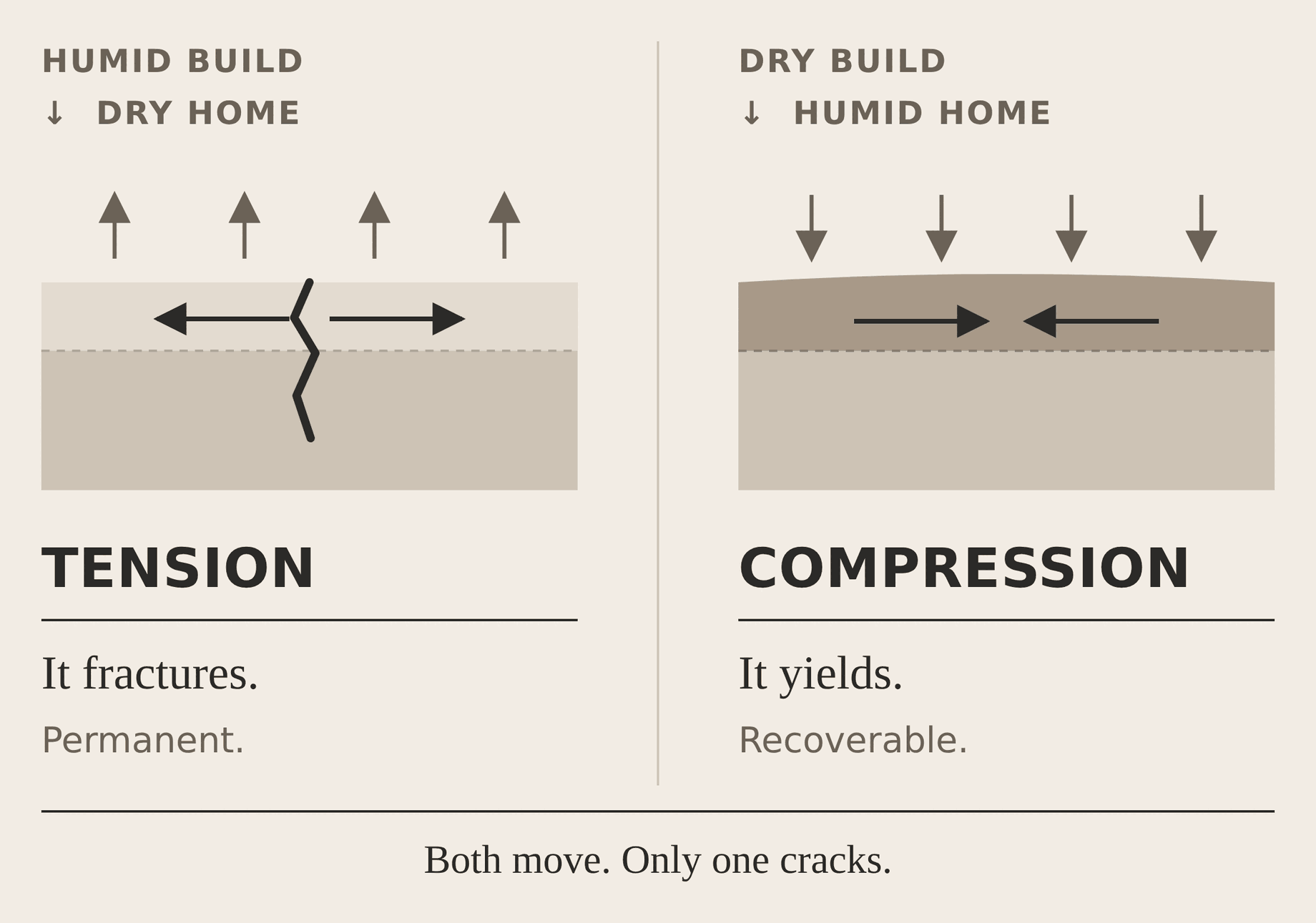
A piece leaves the shop acclimated to the air it was built in. Build it in humid air and send it into a dry house and it has to dry out: tension, which cracks. Build it in dry air and send it into a humid house and it takes moisture on instead: compression, which does not.
A kiln does two jobs. It takes the wood down to a moisture content air drying alone would not reach, and it equalizes the stock so that level is uniform through the thickness and free of drying stress. The second job holds. The first does not. Wood comes back into balance with whatever air surrounds it, and freshly planed stock, its fibers open and unsealed, gets there fast. Stock dried properly and then stored six weeks in a humid shop is acclimated to that shop, not to the kiln. The kiln is early. The shop is last.
Our shop is in Denver, at 5,280 feet, in some of the driest air in the country. The entire facility is conditioned, so the wood sits in the same air from the rack through milling, glue-up and finishing, right up to the day it is crated.
A top acclimated to dry air has already shrunk, slowly, before a single joint was cut. A top built in humid air and delivered into a dry house has not: it is being asked to give up several points of moisture at once, faster than its core can follow. The surface dries and starts pulling. The middle is still wet and will not let it. That gap is the tension, and the faster the change arrives, the steeper the gap.
Very few homes are drier than our shop. A piece leaving this dry has very little left to give up. Shipped anywhere damper, it takes moisture on. Kept here, in a Denver winter or a mountain house, it is already close to where it will live. Either way it never has to dry out hard, and drying out hard is what opens a crack.
Building dry reduces the risk of climate-related cracking, but it does not eliminate wood movement. It is critical that each top settle into its new home before it is fastened into place.
A top sent to an air-conditioned house here in Denver will contract. Fastened before that happens, it can still crack. A top sent to a humid climate will expand instead, and though compression does not fracture wood, a top held rigid while it expands can buckle, curl, tear out its fasteners, or damage the cabinets beneath it. In both cases the damage comes from premature restraint.
So the top sits unwrapped in the room it will live in for at least five days before anything is screwed down. That lets the steepest part of the adjustment happen while the top is still free to move through it: nothing fixed, nothing clamped, no fastener deciding where the stress goes.
Five days is the minimum; ten is roughly the limit. Left longer, a top may dry unevenly and cup. If the room will not be ready, tell us before it ships and we will hold it here.
A top still has to be fastened so its movement goes somewhere harmless. Building dry buys you compression instead of tension. It does not excuse the installation.
Width, sawing pattern, and where a top meets stone are decisions worth making together. A design call takes about twenty minutes — or send us a note if you just have questions.