
Finished & Sealed Butcher Block
and Hardwood Countertops
A beautiful hardwood surface starts with the wood. The same care and attention to detail should carry through every step—especially the finish.
Custom Hardwood and Butcher Block Countertops, Professionally Sealed
The finish decides how your countertop looks, feels, ages, and holds up. It matters at least as much as the wood does.
Every Armani surface is built to order, hand-sanded, and professionally sealed with a finish system chosen for how you'll actually use it. A working butcher block, a kitchen island, a wet bar, a vanity, a restaurant counter — they all ask different things of the wood, and we're not going to pretend one finish covers all of them.
We're woodworkers, not chemists. We don't formulate our own coatings. What we've done instead is work with experts to find the most advanced finishes made anywhere — and the cleanest. No isocyanates. No formaldehyde.
Food-grade mineral oil and organic beeswax. Real Milk Paint's pure tung oil. Rubio Monocoat™ hard-wax oil from Belgium. And Impermio™, our own sealed finish system.
Impermio isn't one product off a shelf — it's a sealer and topcoat specified for the job. Most interior countertops get Milesi's LQA sealer under their BCA topcoat. Outdoor installations, high-gloss bar tops, and the most natural-looking finishes each call for a different stack, and we spec it accordingly.
We'll always tell you exactly what's going on your countertop and who makes it. That seems like the least you should expect.
And the same standard runs through the entire piece — the broad surface, the edges, the profiles, the cutouts. Not just the parts you notice first.
Finished & Sealed Butcher Block: Style, Function, and the Right Finish
People choose butcher block for two very different reasons, and the finish is where that difference shows up.
Sometimes it's about the look. A warm run of walnut next to the range. A white oak island that softens a kitchen full of stone and steel. It's a countertop that happens to be wood, and nobody is ever going to take a knife to it. What it will see is water around the faucet, oil-splatter next to the cooktop, red wine, coffee, cleaning spray, and whatever gets left on it overnight.
Other times it's about the block. A real work surface — the end-grain maple square by the prep sink, the baking station you roll dough on, the top you'd rather cut on than dig a board out of a drawer. Knife marks are part of the point. So is being able to sand it back.
Same wood. Same slab. Different jobs. And the finish that's right for one is wrong for the other.
If you're going for a functional cutting surface: a penetrating finish.
The prep station. The block beside the sink where vegetables get broken down. A baking counter you roll dough on. The stretch of island built to be chopped on rather than looked at. These are working surfaces, and they're the reason butcher block exists in the first place.
A penetrating finish soaks into the wood instead of sitting on top of it. There's no film to chip or peel, so a knife doesn't damage the finish — it marks the wood, which is the entire idea.
Food-grade mineral oil with organic beeswax is the traditional answer and still the simplest. It's food-safe the day it arrives — no cure time, nothing to wait on — and renewing it is a rag and ten minutes. The cost of that simplicity is frequency: daily for the first week, weekly for the next month, then monthly once the wood has drunk its fill.
Pure tung oil asks less of you. We use Real Milk Paint's, cut with citrus solvent so it drives deeper into the grain, and it cures inside the wood rather than simply sitting in it — more protection, and a warm satin depth that keeps developing for years. Real Milk Paint states it meets FDA food-contact standards once fully cured. The tradeoff is that curing takes up to 30 days, and renewing it is more of a job than a wipe.
And here's the part that doesn't get said enough: a block finished this way can be renewed again and again. Sand it, re-oil it, and it comes back new — not repaired, new. A sealed film can't do that; once it's cut through, it's cut through. A block that's been worked on for twenty years can be brought back to the day it left our shop, and then worked on for twenty more.
The trade: it asks for upkeep, and it won't shrug off standing water the way a sealed top will. What you get back is a surface you can actually put a knife to — and one that never has to be replaced.
If you're looking for a waterproof wood countertop and maximum durability: a sealed finish.
Main sink runs. The oil-splattered counter beside the cooktop. Bathroom vanities. Laundry rooms, where the chemicals live. Restaurant tables, bar tops, and commercial installations that see more use in a month than a home kitchen sees in a year. These are the hardest-working surfaces we finish, and this is the toughest finish we make.
A sealed butcher block countertop uses a cured film that stays on the surface and keeps liquid from reaching the wood at all. Ours is Impermio™, built on Milesi's BCA technology — a newer class of coating developed to combine the best properties of polyurethane, acrylic, and catalyzed finishes in a single system. Standing water, red wine, citrus, soap, sunscreen, the ring from a glass nobody wiped up — the finish takes it, not the wood.
It's hard as well as sealed. Milesi tests the topcoat to European standards for scratch resistance and surface hardness, where it outperforms conventional polyurethane and acrylic coatings on both counts. That's what makes it work in restaurant and bar service — dragged plates, glassware, and constant wiping that would wear a residential finish through.
And sealed doesn't mean shiny. Impermio comes in matte, eggshell, satin, and semi-gloss, so the protection is a separate decision from the look. Choose matte and it reads as bare wood across the room; the difference is what happens when someone spills on it.
That's what people mean when they search for a waterproof butcher block countertop, and we'll be straight with you about what it delivers. Solid wood is a living material, it moves with the seasons, and no finish changes that. But a properly sealed top is about as close to maintenance-free as wood gets — wipe it down and get on with your day.
The trade: it isn't a cutting surface, and it can't be spot-repaired the way an oil finish can. Use a board, and it will look like this for a very long time.
If you're going for versatile, everyday durability: a hard-wax oil.
Eating and dining surfaces. A kitchen island you're not chopping on. A table, a bar top, a stretch of counter away from the wet work. Anywhere that sees daily life but not a sink, a cooktop, or the chemicals and oils that come with them.
Rubio Monocoat™ hard-wax oil cures into the top layer of the wood rather than forming a film over it. You get everyday durability with far less upkeep than an oil finish asks for — and the wood still looks like wood rather than something under glass. It can carry subtle color as well, without burying the grain.
The trade: it isn't a cutting surface, and standing water is still not its friend. It does want occasional maintenance — nothing like mineral oil, but more than none. And damage can be fixed in the spot where it happened instead of across the whole top, which a sealed finish can't do — though that's a job, not a wipe-down.
In any case, it arrives prefinished.
Whichever finish you choose, your countertop leaves our shop finished — hand-sanded, sealed, edges profiled, sink cutouts machined and coated straight through the opening. That's the difference between a prefinished butcher block countertop and a raw slab that shows up with the finishing still sitting on your to-do list.
Talk through your project →
Exceptional Wood Deserves an Exceptional Finish
We do not treat finishing as the last step in making a countertop.
Surface preparation, sanding, edge work, finish selection, application, and curing all affect the final result. That is why we work with professional finishing systems from leading manufacturers rather than relying on one finish for every project.
Each serves a different purpose.
Food-Grade
Mineral Oil
A traditional choice for butcher block and surfaces intended for direct cutting.
Mineral oil penetrates the wood rather than forming a hard surface film. It is simple to renew and allows a working butcher block to be sanded, refreshed, and maintained over time.
The tradeoff is regular maintenance.
Pure Tung Oil
For clients who want a natural, penetrating finish with less frequent maintenance than mineral oil.
We use Real Milk Paint Pure Tung Oil blended with Citrus Solvent for better penetration and workability. Unlike mineral oil, tung oil cures within the wood, providing greater protection while preserving a natural feel.
It remains a renewable finish and will require periodic maintenance over its life.
Rubio Monocoat™
Hard-Wax Oil
For general-use hardwood surfaces where a natural appearance and tactile feel are priorities.
Hard-wax oil cures within the surface of the wood, providing greater everyday protection while maintaining a low-sheen, natural appearance. It can also be used to introduce subtle color while allowing the grain and character of the species to remain visible.
Impermio™
Sealed Finish
For applications where moisture, staining, chemicals, and frequent use require a higher level of protection.
Impermio™ is our high-performance sealed finish using Milesi BCA coating technology. It creates a durable protective surface for demanding kitchens, wet bars, vanities, hospitality spaces, and commercial applications.
Hand-Sanded, Then Finished — Before It Ships
Finish quality starts long before any finish goes on.
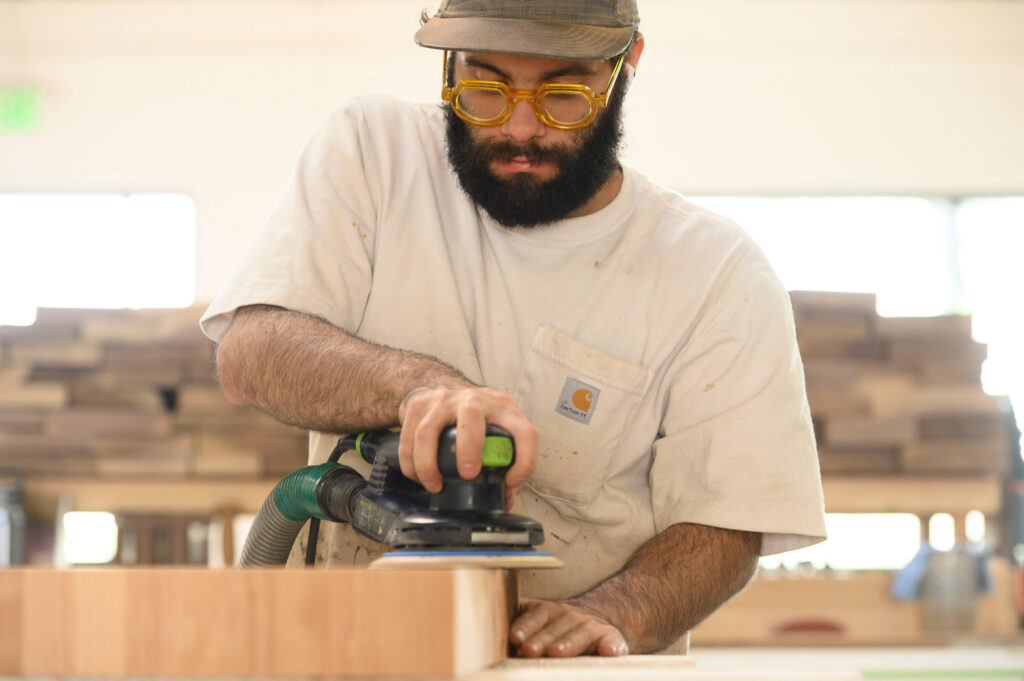
Every Armani countertop is progressively sanded by hand. Edges get refined, profiles get blended, machining marks get worked out — so the finish lands evenly across the whole piece instead of telegraphing whatever happened underneath it.
Compare that to a mass-produced butcher block slab, where final sanding, sealing, edge treatment, and jobsite cutouts are all left to someone else. Usually you.
An Armani countertop leaves our shop as a finished surface.
Protected Without Hiding the Wood
Every finish we use is chosen to reveal the wood, not cover it. That's the whole reason to specify hardwood — the grain, the color variation, the character no manufactured surface can imitate.
Mineral oil deepens the grain and leaves a soft matte surface. Tung oil cures inside the wood and brings out a warmth that keeps developing as it ages. Hard-wax oil sits in the top layer, so the surface stays about as close to raw timber as a finished surface gets. And Impermio protects without clouding what's underneath — from restrained matte to more polished sheens, so the look stays yours to set.
Different levels of protection. Same result: unmistakably real wood, prepared for the way you'll actually use it.
Undermount Sink Cutouts, Finished to Match
Undermount sinks leave the cut edge of the countertop fully exposed—and directly beside one of the wettest areas in the kitchen.
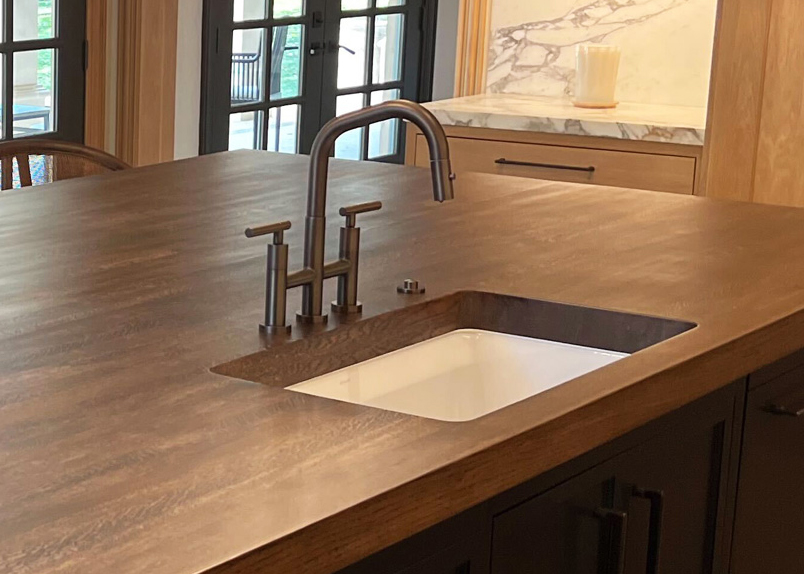
When Armani makes the sink opening in our shop, the cutout is machined, hand-sanded, and finished with the same system used on the rest of the countertop. The exposed edge receives the same attention to color, sheen, surface quality, and moisture protection as the top itself.
With Impermio™, the finish carries through the sink opening to create a continuously sealed butcher block surface across the top and exposed edge.
The result is both better protected and more refined: a sink opening that looks as carefully finished as the rest of the countertop.
For that reason, we strongly recommend having Armani cut and finish undermount sink openings before the countertop leaves our shop.
Made for Long-Term Use
Solid hardwood remains a living material regardless of the finish applied to it.
It will respond to seasonal changes in humidity, and proper design, construction, installation, and environmental conditions remain important to long-term performance.
The finish does not change that.
What the right finish does is allow the surface to perform appropriately for its intended use while preserving the qualities that make solid wood different from stone, quartz, or other manufactured materials.
Natural character. Tactile warmth. Repairability. And a surface capable of aging as part of the architecture.
Trusted by Homeowners, Designers, Builders, and Hospitality Teams
4.9-Star Verified Reviews
Client feedback across custom hardwood surfaces and specialty pieces.
Read verified reviews →
Residential & Hospitality Projects
Built for private homes, restaurants, bars, workspaces, and design-led interiors.
Made in Denver, Shipped Nationwide
Custom hardwood surfaces fabricated in Colorado and delivered across the country.