
Overview
Solid wood is a hygroscopic material which means that it will gain and lose moisture from the air depending on the conditions in its surrounding environment. Consequently, solid wood products will expand and contract in accordance with these changes, an effect known as wood shrinkage. However, wood does not shrink in a uniform manner. There are three directions, or planes, in which wood shrinkage occurs.
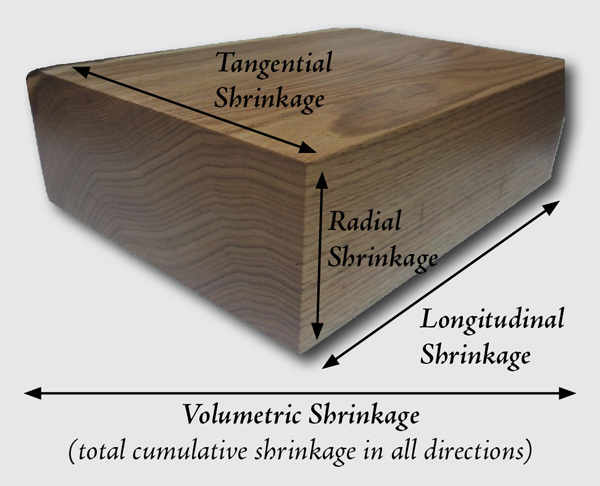
In order from most to least movement (when referencing a plain-sawn board of lumber):
1. The tangential plane, or in the direction of the width of the board
2. The radial plane, or in the direction of the height, or thickness, of the board
3. The longitudinal plane, or along the length of the board
For this reason, solid hardwood tops need to be properly supported to simultaneously accommodate and limit this movement. If not properly supported, your piece(s) could be liable to split, crack, or warp.
Support requirements for Wide Plank and Edge Grain countertops:
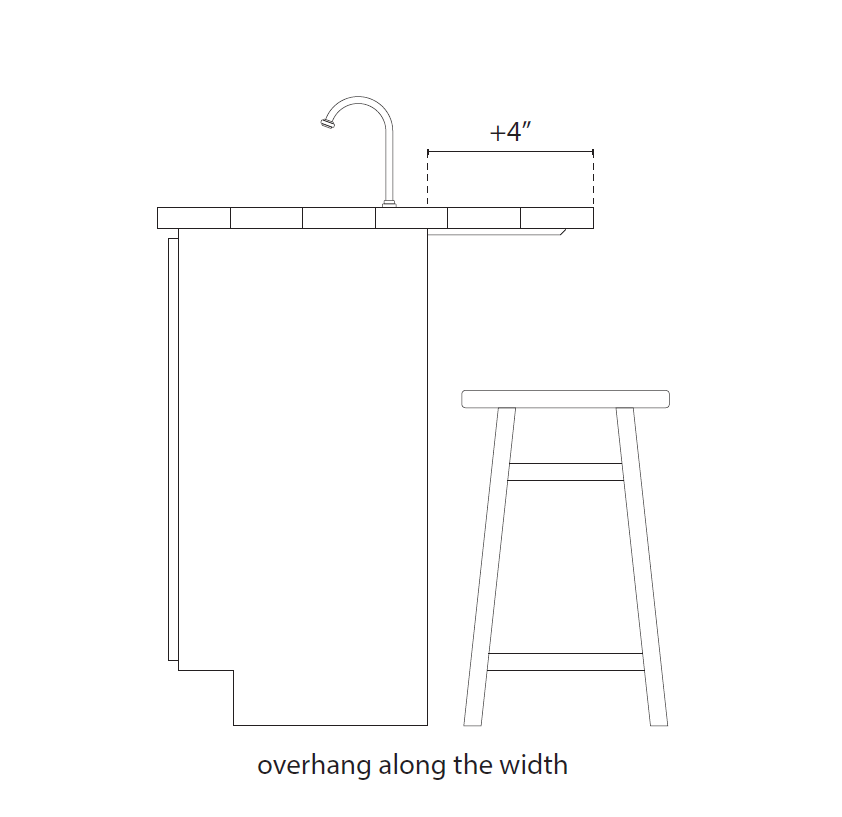
Width Overhang
- For overhangs like pictured below that extend along the width (aka depth), you’ll want to factor in supports once your overhang exceeds 4” from the edge of your base. These supports should start no more than 8” from each edge and be spaced 24” or less apart.
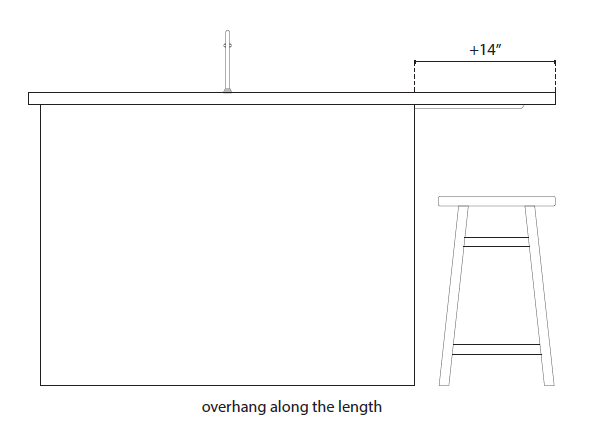
Length Overhang
- For overhangs along the length of your piece, you’ll want to factor in supports once you have max 14” extending from the end of your base. You’ll want to space these supports in the same way; 8” or less from each edge & 24” or less apart.
Support requirements for End Grain countertops:
Due to their construction style, End Grain countertops require more structured support than their Wide Plank or Edge Grain counterparts. If your End Grain piece will not be fully supported by base cabinetry, we advise reaching out to one of our staff to review support requirements for your individual project's needs.
Support requirements for tabletops, desktops, etc.:
For pieces that will utilize legs or frames (as opposed to fully supportive cabinetry), it is imperative that your frame extends the depth of the top to provide the necessary support. You should have no more than 4" of overhang on either the front or back edges and no more than 14" of overhang on the ends, assuming the grain is running left to right when standing at the front of your piece. Should your design incorporate hairpin legs or similar that cannot properly support a hardwood top, please feel welcome to reach out to a designer to discuss recessed steel channels, wood cleats, a custom apron, or other integrated support options.
Regardless of the type of supports used, you want to be sure that your attachment points include elongated holes, or slots, so that your wood countertop can "breathe" with the changes in relative humidity.
Should you have any questions regarding the nature of your project or would like to inquire about our support options, we encourage you to reach out to one of our designers at (720) 414-1393 for more details.